
Hiking warm coats
Best Winter Coats for hiking
Let’s face it: You may love the cold, but no one loves being cold. Catching a chill is a quick way to turn a fun day out in the mountains or the woods into an ordeal that leaves you dreaming about a hot drink and a roaring fire while you slog through the snow. And when it comes to keeping yourself comfortable in the fourth season, picking the right insulation is key.
A perfect winter jacket won’t just let you survive in the cold, it will let you thrive in it. To find the best insulation of the year, we sent testers across America to put the candidates through their paces on subzero backpacking trips, long ski days in the backcountry, mountain ascents, and more. These 10 rose to the top for our best winter jackets: Pick your perfect one, and the cold will never keep you inside again.
What to Look for in a Winter Jacket
There’s no such thing as a perfect winter jacket: Like any apparel, the best way to shop for a jacket is to match it to your intended use. Need something for active use, like fast hikes or backcountry skinning? Fleeces are toasty mid-layers, and vent heat well; they also tend to be relatively low-profile, which is ideal when you’re layering them under a shell. The downside is that they don’t block out the wind.
For maximum warmth, consider a puffy, either down or synthetic. Insulation-filled baffles provide maximum warmth for minimum weight and bulk, meaning you can store your jacket in your pack until it’s needed. Durable water-repellent puffies can usually shed mild to moderate precipitation, and often block wind without the need for a shell, too. Downside: They usually don’t vent heat as well as a fleece or hybrid jacket.
Warmest Insulated Jacket: Mountain Equipment Trango Jacket
- Price: $325
- Weight: 1 lb. 10 oz.
- Best for Subzero temps
The Details
Don’t expect breathability with a jacket this insulated: According to one tester, he had to open the zipper any time temps got above 20°F in camp, and the Trango was too hot to wear while moving over about 10°F. This bulky jacket packs into an included stuff sack to about the size of a rugby ball, but for our tester, that was reasonable considering its warmth. The 40-denier nylon face fabric never saw any damage. Considering how cold the Trango’s ideal environment is, the rain was never an issue, but a PFC-free DWR coating prevented snow from wetting the material. Testers also lauded a number of storage options: two hand pockets, two chest pockets, and two drop pockets inside.

Most Eco-Friendly Insulated Jacket: Houdini Mono Air Houdi
- Price: $200
- Weight: 1 lb. 5 oz.
- Best for: Staying warm while having the planet

As much as we can talk about jackets pushing the boundaries of warmth, packability, weight, or features, insulation that doesn’t hammer the environment is more important than any of those over the long term. The Mono Air Houdi is at the forefront of that trend. Houdini partnered with Polartec to improve on the latter’s Power Air fabric so it now sheds 80 percent fewer microfibers compared to a standard fleece. (Rather than using short fibers that can fall out, it uses much longer ones woven into “cells” that do a better job of holding tight to each other.) The material is also fully circular: It’s made from recycled plastic waste and is 100 percent recyclable itself. But the Mono Air doesn’t skimp on performance. Our tester was comfy hiking in the jacket while wearing it over a light baselayer on days in the low 30s (or using it as a layering piece in colder temps), and it breathed well while we rock climbed in New York’s Shawangunks in the mid-40s. The best part: Houdini made the design fully open-source, meaning other manufacturers can copy pieces of the recipe to make similarly green garments.
The Details
One tester lauded the jacket’s durability: “I wore this as an outer layer while bouldering near Great Barrington, Massachusetts, often brushing against the abrasive rock, and the Mono Air’s tightly woven face fabric shrugged it off.” That weave didn’t help with wind, though, which moved right through it and can’t handle much more than a sprinkle. The jacket also has two zippered hand pockets.
Most Versatile Insulated Jacket: Fjällräven Keb Wool Padded Jacket
- Price: $280
- Weight: 1 lb. 2 oz.
- Best for Doing (almost) anything

Our Take
You heard it here first: Wool is the most versatile textile, full-stop. The Keb leverages this common— yet underrated—material for do-it-all temp control. One Adirondacks-based tester kept this jacket on him everywhere from a sweaty mid-teens skin up Mt. Colden, to cross-country skiing at the freezing mark, to resort skiing in the upper 30s. The lofted wool insulation, which successfully regulates a wide range of temps, proved to be the ideal quantity in almost every scenario. A 50-denier polyester face fabric with a PFC-free DWR coating held light snow at bay, and the Keb layered easily under a shell or heavier puffy. “I think I wore it every day between January and March,” our tester says. “It was a fit for every activity.”
The Details
As is typical with a “master of none,” the Keb doesn’t move moisture or dry out as quickly as some of the more breathability-oriented jackets in this test. But when it didn’t fit the bill, it packed down to the size of a cantaloupe to tuck in a pack.
The two exterior chest pockets (big enough to slip skins into) and two hand pockets all zip shut, and the hood cinched comfortably for hikes and summit transitions, but wouldn’t fit over a helmet.
Best Fleece Midlayer: Helly Hansen Elevation Shield/Aurora Shield Fleece Jacket
- Price: $180
- Weight: 1 lb. 1 oz.
- Best for Foul weather
Our Take
The Aurora Shield couldn’t help our tester stay on her feet during a windy ski tour on Colorado’s Loveland Pass, but it didn’t let the gale-force her inside. “It was the windiest day I’ve ever experienced, with gusts up to 50 mph,” she says. Tightly-woven polyester/elastane face fabric with a PFC-free DWR held the wind and flying snow at bay, and just the jacket and a base layer were enough to keep her toasty while she tried (and failed) to find a sheltered spot with temps in the 20s. Our tester wouldn’t have wanted to wear the Aurora Shield in a rainstorm, but even heavy snow couldn’t get it out after an hour of exposure.
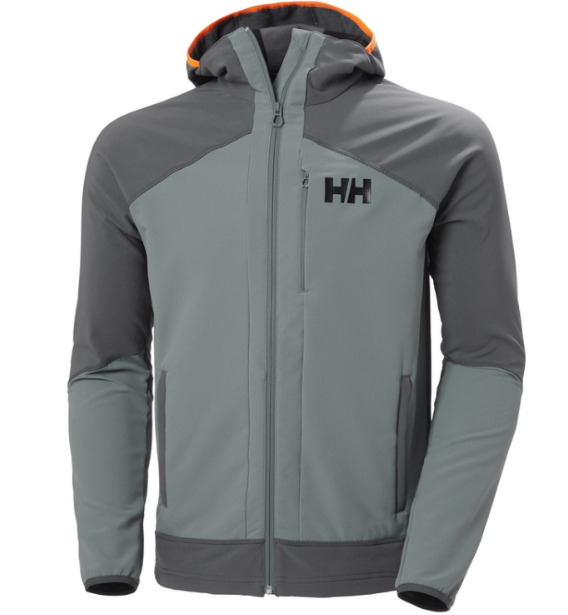
The Details
The light, four-way stretch fleece fabric kept us warm on ski tours with temps down into the single digits. The Aurora Shield (the Elevation Shield is the men’s version) breathed well enough to be worn over just a base layer while skinning up a resort on warmer 30°F nights. One tester lauded the jacket’s snug-but-stretchy fit, hand pockets, and phone-size chest pocket, but wished the elastic-rimmed hood was slightly bigger to fit more comfortably over a ski helmet. (Though without a helmet on, it snugged down tight enough to not be affected by wind.)